

The Wannabe Owen Jones: When Propaganda Wears a Press Badge
When grotesque allegations meet zero verification, and a narrative does the rest.

Owen Jones has outdone himself. Not in journalism—don’t be ridiculous—but in imagination. He’s now pushing the claim that Israel trains dogs to rape Palestinians, delivered with the confidence of a man who’s skipped the evidence and gone straight to the conclusion. Not “there are allegations”. Not “this needs verifying”. No—overwhelming evidence. Case closed. Pack it up, lads, Owen’s cracked it.
The only problem is… he hasn’t.
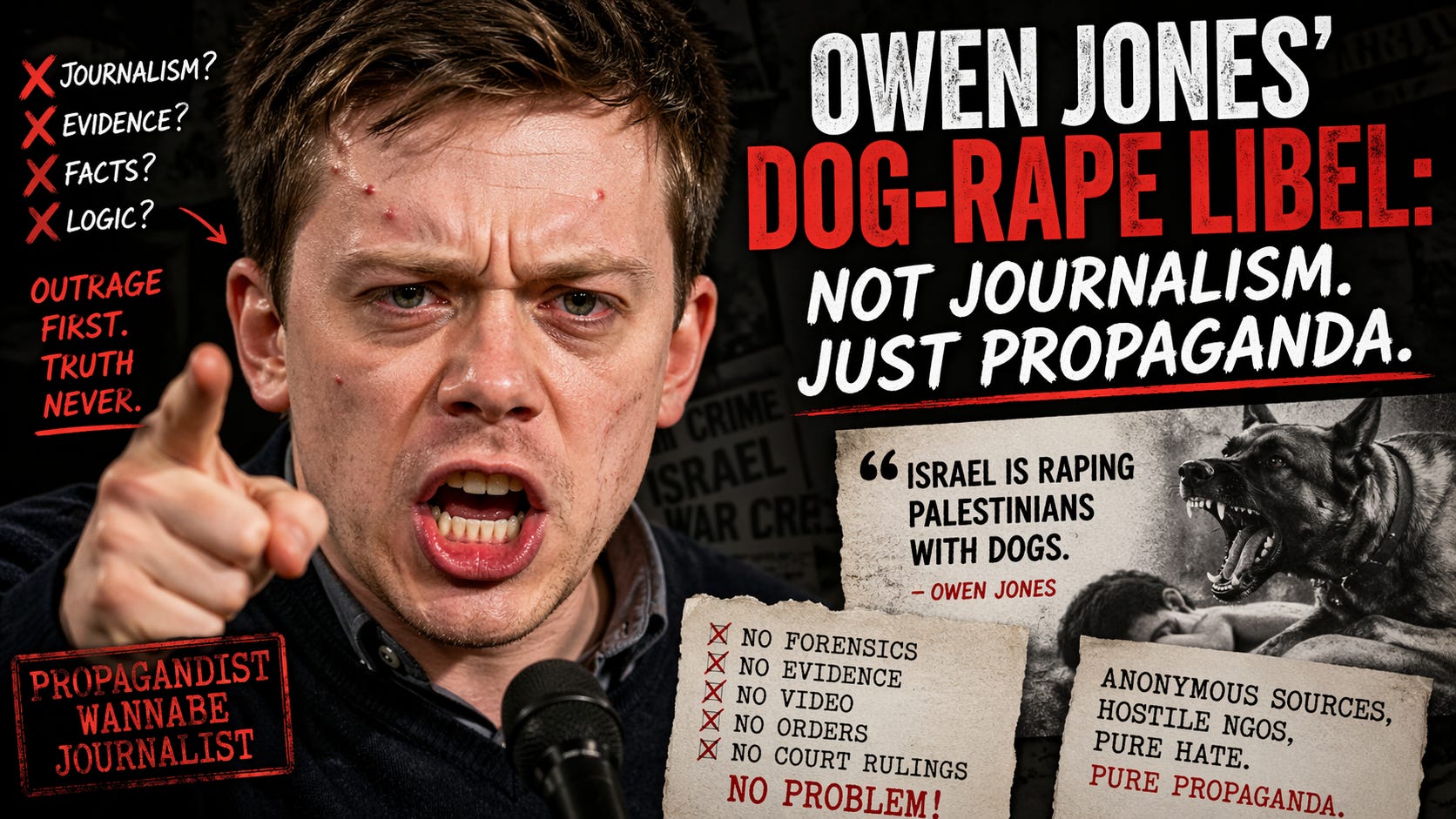
Because when you look for this “overwhelming evidence”, you find something a bit less overwhelming and a lot more… airy. Testimonies filtered through NGOs that already think Israel is guilty of everything from colonialism to climate change, plus an “analyst” citing anonymous guards. Anonymous guards are doing heroic work here. They exist just enough to support the claim, but not enough to be checked, questioned, or—God forbid—proven wrong. It’s journalism’s version of an imaginary friend.
And from this, Jones builds a full-blown narrative of systematic dog-rape as state policy. Not a rogue incident. Not an allegation needing scrutiny. A system. A programme. Presumably with a training schedule and a PowerPoint.
You’d laugh—if it wasn’t being presented as fact.
A proper journalist would hit the brakes. Big claim, thin evidence. You’d start with doubt. You’d foreground the gaps. You’d say, “We don’t know.” But Owen Jones isn’t interested in journalism. He’s a propagandist with a column, a wannabe reporter playing dress-up in the language of facts while doing the exact opposite.
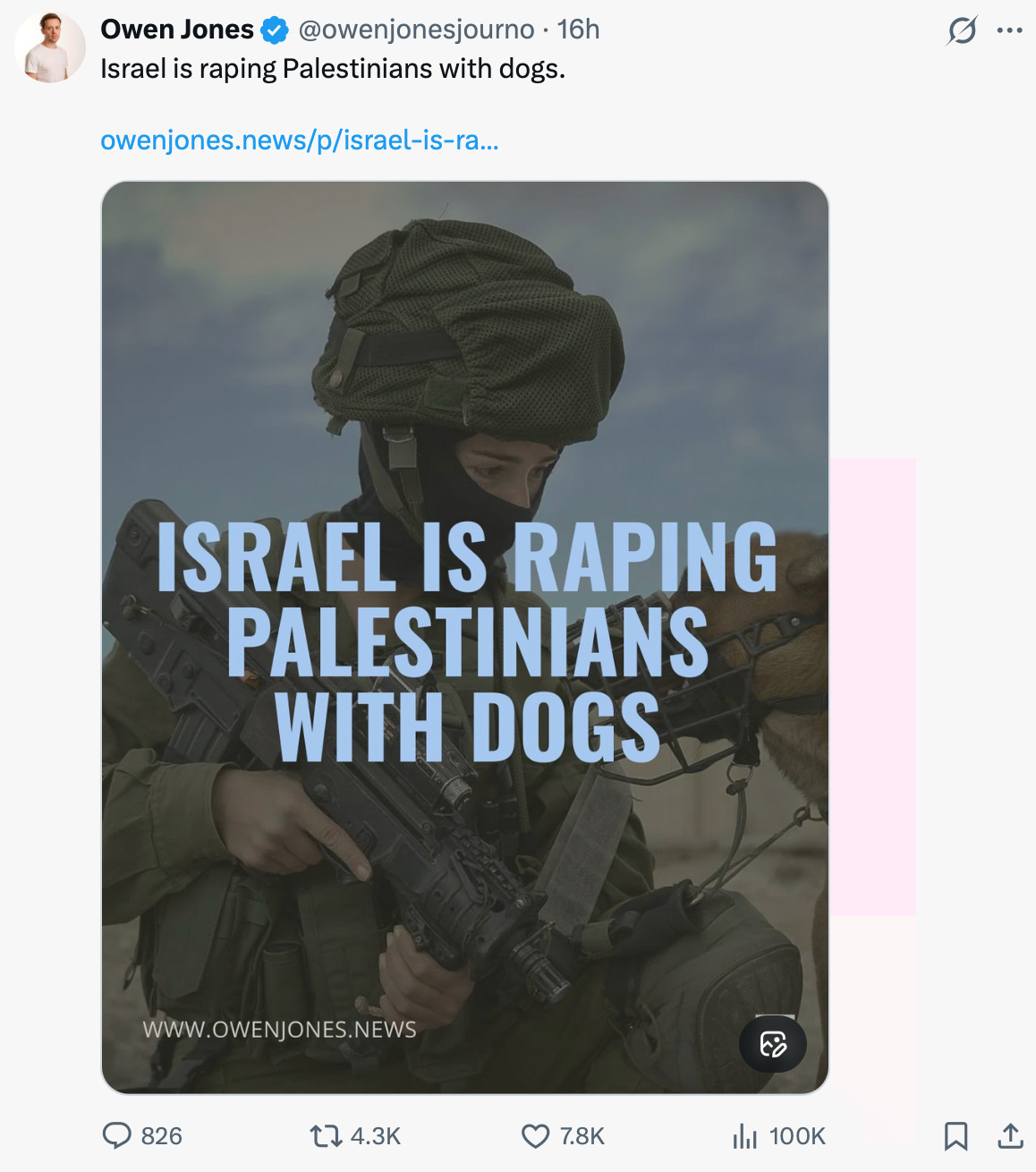
This is how it works: replace evidence with emotion, replace verification with repetition, and if anyone asks awkward questions, treat them like they’ve just defended the crime. Not mistaken—morally compromised. It’s not reporting. It’s narrative enforcement.
And Jones is very good at it. Not at finding truth—but at packaging outrage.
Because the accusation is the point. The more grotesque it is, the less people feel allowed to question it. You don’t need proof if you can generate enough disgust. You just need volume, certainty, and a straight face.
Try running his method anywhere else. Imagine accusing any other group of something this medieval based on anonymous sources and hostile intermediaries. You’d be laughed out of the room. Or sued. Probably both. But here? It’s “brave”. It’s “important”. It’s Owen being Owen—confidently wrong, loudly so, and somehow still invited back for more.
We’re already in a culture where calling Israel “genocidal” or “Nazi-like” is treated as a respectable opinion. Disagree, and suddenly you’re the problem. So why stop there? Why not escalate? Add something more shocking. More lurid. Dogs, rape—why not? If the goal is maximum outrage, subtlety’s just getting in the way.
And that’s the real story here. Not what Israel is or isn’t doing, but what people like Owen Jones are willing to say without evidence if it fits the narrative they’ve already decided is true.
Because let’s be honest—this isn’t journalism. Journalism asks questions. Journalism tests claims. Journalism is supposed to be allergic to certainty without proof. What Jones is doing is the opposite. He starts with the answer and works backwards, cherry-picking whatever fragments he can find to hold it together.
It’s not investigation. It’s confirmation bias in a nice jacket.
Now, the obvious point—because apparently it needs stating: if any Israeli soldier committed anything like this, investigate it. Properly. Transparently. Punish it if proven. That’s what real accountability looks like.
But if you’re going to claim it’s systematic—policy, doctrine, something organised—you don’t get to base that on anonymous whispers and ideologically convenient testimony. You need evidence that holds up when someone actually looks at it. Documents. Forensics. Corroboration. Not vibes.
Without that, you’re not exposing a crime. You’re inventing one.
And Owen Jones, in this case, looks less like a journalist and more like exactly what he accuses others of being—a propagandist. A wannabe reporter who’s mistaken outrage for evidence and clicks for credibility.
It’s embarrassing. It’s irresponsible. And worst of all—it’s effective.
Because somewhere out there, someone’s reading this and thinking, “Well, if Owen says it…”
That’s the problem. Not just that it’s stupid—but that it spreads.