

Metroslamic Police: Welcome to Londonistan
The capital of Wokestan, where intimidation gets facilitated and dissent gets kettled

Londonistan has a new hobby: pretending it’s the moral capital of the free world while behaving like a badly run security state with a diversity officer. And the Metropolitan Police—once the supposed grown-ups in the room—have apparently decided their brand refresh is: “Now with extra batons.”
It starts the way these things always start in Wokestan’s capital: not with a bang, but with that particular London soundscape—sirens, shouting, and the faint wheeze of civic hypocrisy tightening around your throat like a “community safety” lanyard.
A crowd gathers outside a foreign embassy. Not Parliament. Not Downing Street. Not the BBC canteen. An embassy. People aren’t there to smash British institutions, burn cars, or cosplay revolution as a weekend hobby. They’re there to shout one very basic demand at the British state: stop cosying up to the Islamic Republic’s enforcers; treat the IRGC like what it is; stop treating monsters like “stakeholders.”
And then—because this is Londonistan—British policing swings into action with the kind of ferocity normally reserved for:
people who refuse to clap for the correct cause, and
anyone who looks as though they might still believe in the concept of a nation-state.
The line forms quickly. A thick wall of helmets and shields. Kettling begins. People try to move away—normal human behaviour, last I checked—and get shoved back in. The vibe is less “public order” and more “we’ve been waiting years to try this kit on someone harmless.”
And here’s the first tell that something is rotten: the speed. The competence. The sudden, almost touching enthusiasm. “Suddenly they’re very competent. Suddenly they’ve been trained properly. Wow.”
Yes. Exactly. Funny how the Met can locate its spine when the target isn’t going to bite back—when the crowd isn’t protected by fashionable intimidation, political cover, or that sacred London pass: the right ideology.
Because in this city, everyone knows there are protests… and then there are protected protests.
Two-tier policing isn’t a conspiracy. It’s a business model.
In Londonistan, the police don’t “police.” They curate. They manage reputational risk. They weigh up whose outrage matters, whose intimidation will make the wrong headlines, whose lawyers will go nuclear, whose friends sit on panels, and whose supporters can turn a high street into a no-go zone with a megaphone and a moral licence.
So what happens when the crowd isn’t the usual protected species? When it’s not the march that gets a sympathetic BBC package and a “community leaders call for calm” follow-up? When it’s not the protest that can scream, threaten, intimidate—and be treated like a delicate cultural flower that bruises if you enforce the law too loudly?
What happens is: the batons come out.
That detail matters, because even the people on the ground are shocked by it. “I genuinely have seen the police in the UK using batons in a very long time,” one voice says, reaching back to rare public moments when the Met last acted like this.
Not because batons are mythical objects. But because London’s modern policing strategy is selective courage. Soft where it’s dangerous. Hard where it’s safe. It’s not bravery. It’s bullying with a pension.
And if anyone dares call it out, the response is always the same: How dare you politicise policing?
As if policing hasn’t been political since the first copper decided “public order” means “order for the public who matter.”
The “free press” moment: when the Met decides journalism is a contact sport
One of the most grotesque details of the night isn’t even what happens to protesters. It’s what happens to someone doing the one job that’s meant to keep power honest: filming.
A journalist is pushed. Threatened. The camera is struck. Not once. Not “a misunderstanding.” Repeatedly. “They basically hit [the] camera,” someone says, incredulous at the audacity. Another moment catches the same theme: “What happened to free media, free press?”
That question lands like a brick because it isn’t rhetorical anymore. Londonistan doesn’t need censorship laws when it can do something cheaper: make filming physically unpleasant and legally risky.
The message is simple: don’t record this. Don’t show people what “public order” looks like when the wrong group shows up.
Because “community cohesion” is much easier to maintain when the footage doesn’t go viral.
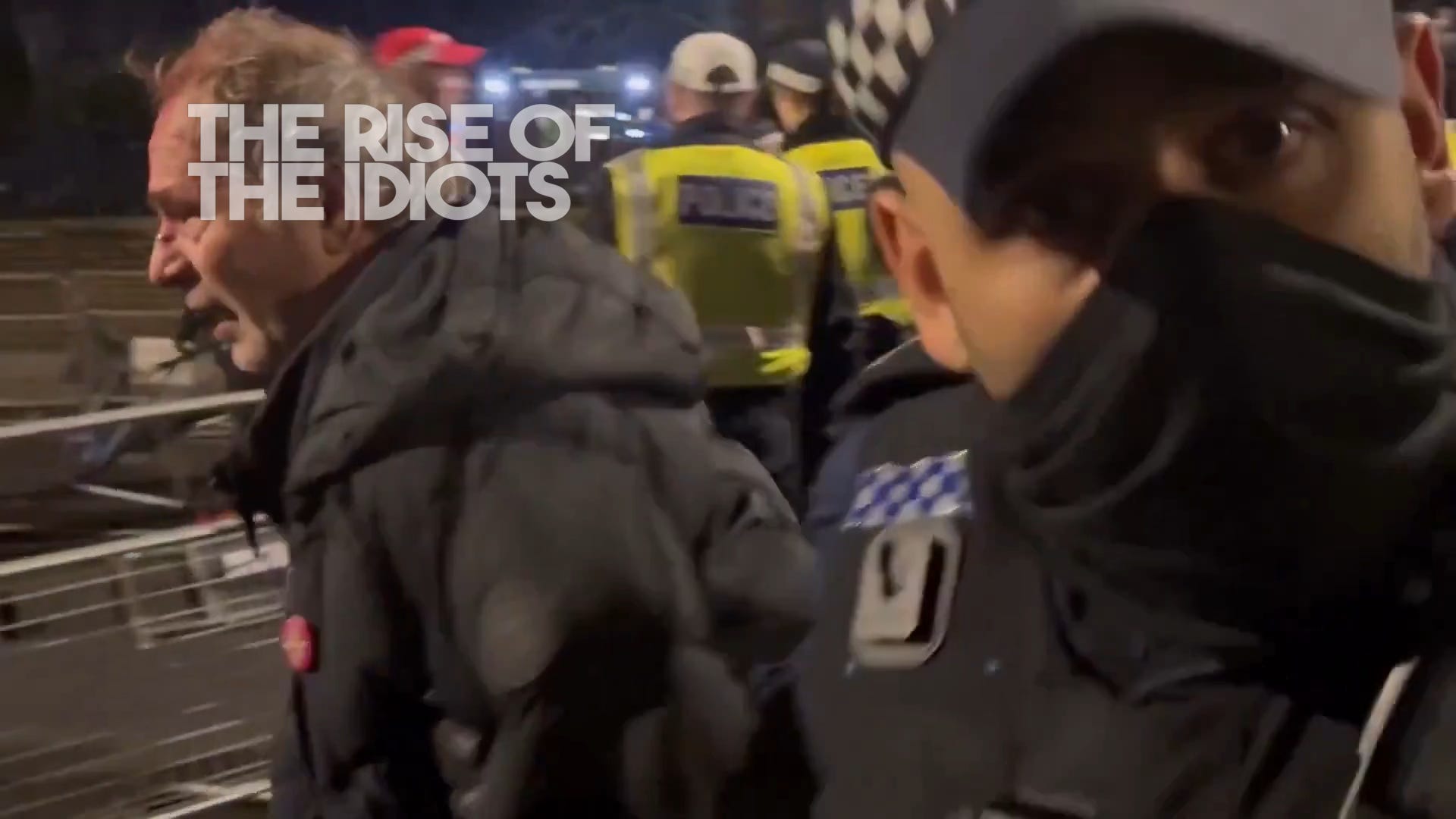
And you can practically hear the double standard humming underneath it: If this were the BBC being shoved around, the Prime Minister would apologise in a heartbeat.
But a smaller outlet? A less protected journalist? In Londonistan, that’s just “operational necessity.” That’s “don’t interfere with my officers!”
Translation: Don’t interfere with the narrative.
The elderly man: the moment Londonistan stops pretending
Then comes the part you don’t get to hand-wave away with policy jargon.
An elderly man goes down. Seventy, according to voices at the scene. Not a “young football hooligan,” as one person points out—because London’s establishment always likes its victims to be unsympathetic. It’s much easier to justify bruises when you can call someone “far-right” and go home feeling virtuous.
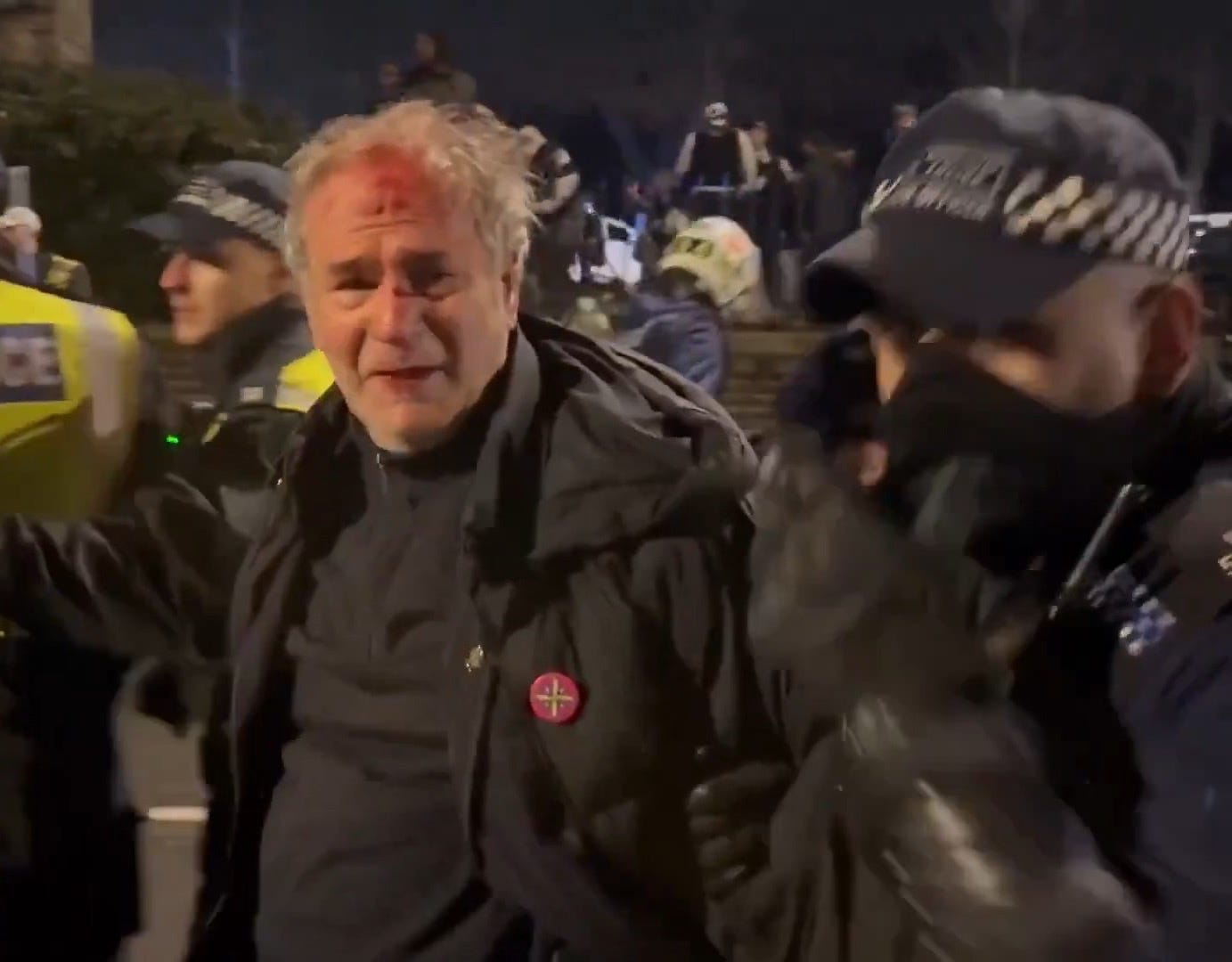
But an elderly man? That’s awkward.
And yet the night keeps moving with that same cold momentum: more bodies, more shoves, more chaos. Someone says people injured and arrested skew older and female—again, inconvenient demographics if you’re trying to sell this as “necessary force” against “threatening extremists.”
There’s mention of a head injury—blood. There’s a leg—possibly broken. There’s panic and disbelief and the sort of helpless rage that hits when the state turns its strength on someone who clearly isn’t a threat.
And then, insult piled onto injury: where’s the ambulance?
Repeated again and again. The question isn’t poetic. It’s logistical. You batter people, you get them help. That’s the minimum a civil society owes its own citizens, even when it arrests them. Especially then.
But Londonistan has priorities. And tonight, those priorities appear to be:
protect the embassy building,
dominate the optics,
and make sure nobody records too much of it.
“Who gave the order?”
That question appears in the air like smoke. Because this doesn’t feel like random scuffling. It feels directed. “There was an order… we have to find out who from the top.”
That matters. If this is “policy,” then it isn’t a bad apple. It’s a bad orchard.
And this is where Sadiq Khan becomes unavoidable, because London’s political class has designed a structure where accountability is like a bar of soap: always slipping away, always landing somewhere else’s responsibility.
The mayor will do the usual dance: operational independence.
The Met will do their standard line: we acted proportionately.
The Home Office will do its favourite trick: we’re monitoring the situation.
And the public will be expected to swallow all of it while watching footage of batons, kettling, and an elderly man with a bleeding head.
But let’s be honest: Londonistan doesn’t run on independence. It runs on incentives. On what will be tolerated, what will be rewarded, and what will be punished.
And tonight, the incentive structure is screaming.
Because nobody in power is genuinely afraid of these protesters. The voices on the ground even say it out loud: the crowd is unarmed; the protest is peaceful; the focus is the embassy, not British buildings.
This isn’t a mob hunting strangers down Oxford Street. This isn’t a crowd stamping towards a synagogue with “globalise the intifada” energy. This is a group that can be pushed around without triggering the political class’s fear reflex.
So they get pushed around.
That’s two-tier policing in one sentence.
London’s magical resource problem: always broke, except when bullying is available
Londoners are constantly told there aren’t enough officers. Not enough resources. Not enough capacity to deal with theft, stalking, assaults, grooming gangs, knives, burglaries, the slow-motion collapse of basic order.
Then a crowd appears outside one embassy and—miracle of miracles—there are suddenly loads of officers. “The number of police officers out tonight in one area… they keep telling us they don’t have enough police officers to catch criminals… suddenly they have enough resources.”
It’s like watching a council claim it can’t afford potholes, then unveil a £4 million “inclusive pavement experience” made of recycled feelings.
Londonistan always finds money and manpower for the things that protect the narrative. It’s almost inspiring, if you like your inspiration dipped in contempt.
The contrast London refuses to discuss: Jews, intimidation, and the “wrong kind” of victim
Now, let’s address the thing everyone in polite society tiptoes around like it’s a puddle of acid: how London treats Jews.
Because the reason two-tier policing feels so obscene isn’t just that one group gets hit and another doesn’t. It’s that the group that reliably gets left exposed—again and again—are Jews.
This isn’t theoretical. There are examples in the record of exactly how casual and normalised this intimidation becomes.
A Jewish Chronicle reporter describes a London bus incident in Golders Green: Jewish schoolchildren on board; a man shouting “Get the Jews off the bus”; threats to “burn the bus” and “burn the Jews”; the driver lets the man back on; the police response—initially—amounts to: if the driver doesn’t stop, we can’t send police.
Read that again. Children. Threats of burning Jews. And the system’s first instinct is procedural shrugging.
Or take the “boycott” theatre that so often slides into direct hostility. A London coffee shop displays a sign: boycott Israeli goods—then edits it into the classic British cop-out: “We are not anti-Semitic, but anti-fascist. Jews are as welcome here as anyone else.”
Translation: Jews are welcome, but only the kind of Jew we approve of. Please leave your identity at the door with your coat.
And when activism turns from slogans into vandalism, it’s still Jews who pay. A Birmingham supermarket ends up removing kosher items after BDS demonstrators burst in and damage kosher products.
So the “activists” don’t punish a government. They punish people buying matzo ball soup mix. Because, in this worldview, Jewish life is always collateral.
That’s the atmosphere Londonistan has been marinating in for years: where anti-Israel mobilisation provides cover for intimidation that just happens—mysteriously—to land on Jews.
So when people say “Hamas supporters are allowed to harass Jewish businesses,” they aren’t pulling it from thin air. They’re describing a pattern London keeps normalising: the conditional belonging, the intimidation, the casual threats, the institutional reluctance to confront it with force.
And then, on a night where the crowd isn’t fashionable enough to be protected, the Met deploys a level of physical aggression that Jews in this city could only dream of seeing directed at the people who menace them.
That’s the sickness.
“How come the riot police are never out for the Muslims?”
That question is voiced openly at the scene. It’s raw, it’s blunt, and it’s politically radioactive—which is why London’s commentariat will pretend it wasn’t asked.
But it doesn’t come from nowhere. It comes from watching London’s policing calculus in real time:
If a protest comes with the potential for being labelled “Islamophobic” if policed firmly, the Met suddenly develops a passion for “facilitation.”
If a protest comes with the potential for real backlash—social media storms, community pressure, political headaches—enforcement becomes interpretive dance.
If a protest comes from people who don’t have those levers, the Met becomes “robust.”
That isn’t “community policing.” It’s risk management. It’s policing as PR.
And the ugliest truth is this: Londonistan’s leadership would rather offend law-abiding protesters than risk offending the people who have proved they can turn intimidation into a weapon.
The embassy as sacred ground, the British public as disposable
There’s another line that sits beneath everything: the idea that the embassy is treated like sovereign ground—protected, prioritised, guarded with zeal.
Fine. Embassies get protection. That’s normal.
But here’s what isn’t normal: treating British citizens like the enemy in their own capital, while acting as bouncers for an Islamist regime’s outpost.
The crowd’s demand—stop supporting terrorists, designate the IRGC, deport the regime’s operatives—should not be outrageous in a country that claims to take extremism seriously.
And yet the response is: kettling, batons, assaults, arrests, and a hostility to filming that screams discomfort with scrutiny.
Londonistan has developed a warped hierarchy of whose safety matters. The building matters. The optics matter. The narrative matters. The people? Optional.
Sadiq Khan’s London: diverse, inclusive, and weirdly tolerant of intimidation
Khan’s defenders will do what they always do: recite “diversity” like it’s a magic spell that prevents civil decline. But “diversity” is not a substitute for law. It’s not a replacement for equal protection. It’s not a licence for selective enforcement.
And what’s happening under Khan is not multicultural harmony. It’s a kind of anxious appeasement where the state bends towards the loudest intimidators and compensates by over-policing the safer targets.
That’s not “progress.” That’s a city being trained—slowly—to accept that intimidation works.
If London feels like it’s slipping, it’s because it is. Not into sharia fantasies or tabloid nightmares—but into something more banal and more British: a bureaucracy so terrified of accusations that it stops enforcing norms evenly.
And once even-handed enforcement dies, everything else follows. You don’t get trust. You get factions. You don’t get cohesion. You get rival mobs learning the same lesson: the state only respects pressure.
The final insult: the media silence
There’s a recurring expectation that this won’t be covered properly, if at all. “This won’t be on mainstream media… exclusively being reported by us,” goes one line of commentary.
And whether or not that’s hyperbole, it points to something real: the way London’s gatekeepers filter violence through ideology.
If police act aggressively against a fashionable cause, it’s front-page moral crisis. If police act aggressively against an unfashionable cause, it’s “complex,” “contextual,” “a difficult night for officers.”
And if the victims are Jews? Too often it’s a brief mention, a quiet stat, and a plea not to “inflame tensions.”
As if Jewish safety is an optional extra that might upset the aesthetic.
Londonistan isn’t being “controlled.” It’s being managed into submission.
So here’s the real question behind all of this—bigger than one night, one embassy, one police line:
Who controls London?
Because it doesn’t feel like the ordinary public does. It doesn’t feel like equal law does. It feels like the city is run by a coalition of bureaucrats, risk-averse politicians, and ideological enforcers who decide—case by case—who gets rights and who gets a baton.
And when people say “two-tier policing,” they don’t mean a grand conspiracy with a villain stroking a cat. They mean the lived reality of Londonistan:
Some crowds get “facilitated.”
Some crowds get “robusted.”
Some communities get told to keep their heads down.
Some communities get treated as untouchable.
That’s not policing. That’s a social contract being rewritten without a vote.
And if that sounds dramatic, tell it to the elderly man on the ground. Tell it to the journalist being shoved away from the truth. Tell it to the people asking—over and over—where the ambulance is.
Londonistan is learning, in real time, what happens when a state loses the courage to be fair: it compensates by being cruel—selectively.
And the longer this continues, the more the city will resemble the places it claims to be morally superior to. Not because of immigration. Not because of diversity. But because of cowardice in power.
Cowardice dressed as “sensitivity.”
Cowardice disguised as “community relations.”
Cowardice enforced with a baton.
That’s the London settlement now: the wrong people get policed hard, because the right people have become too scary to police at all.
And Sadiq Khan can keep smiling for the cameras while London’s reality fractures underneath him. In the end, history doesn’t care about slogans. It cares about whether the state treated its citizens equally—especially when it was inconvenient.
Right now, Londonistan is failing that test.