

How Do You Miss Auschwitz?
The Red Cross Didn’t Pull the Trigger, But Did Look Away.

Every now and then, history produces a document so absurd that you assume it must be fake. Then you check, discover it is real, and briefly lose faith in the species.
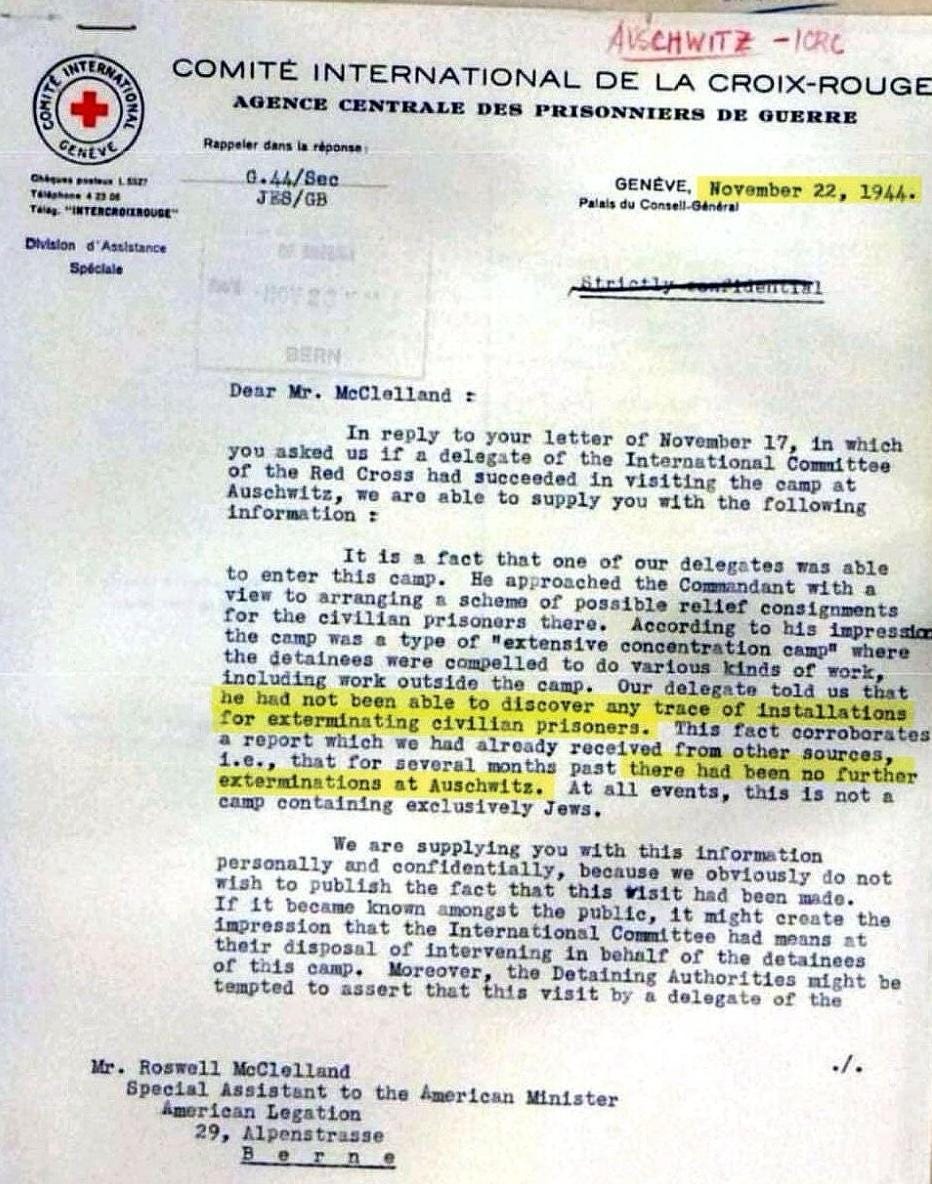
In November 1944, the Red Cross produced a report relating to Auschwitz. Its delegate had not found evidence of extermination facilities or the systematic murder of Jews.
Auschwitz.
In 1944.
It is rather like inspecting the Titanic halfway to the seabed and reporting that the drinks service appears slightly delayed.
To be clear, the Red Cross delegate was not given unrestricted access to Auschwitz-Birkenau. He did not inspect the gas chambers or crematoria. The Nazis controlled what he saw, because apparently genocidal dictatorships are not famous for transparent site visits and honest TripAdvisor reviews.
Auschwitz was an extermination camp. More than a million Jews were murdered there. That is not the question.
The question is how one of the world’s most respected humanitarian organisations managed to stand so close to history’s greatest crime and fail to expose it.
The answer seems to be a mixture of limited access, institutional caution, neutrality and bureaucracy. In other words, all the things organisations describe as principles shortly before issuing an apology seventy years later.
The International Committee of the Red Cross has since acknowledged that it failed Europe’s Jews during the Holocaust. It did not create the camps. It did not operate the gas chambers. But it failed to recognise, confront and publicly expose what was happening with anything approaching the urgency it deserved.
That matters because we still have an almost childish faith in institutions. Give an organisation a famous logo, a headquarters in Geneva and enough people wearing lanyards, and suddenly we assume it possesses wisdom unavailable to ordinary mortals.
It does not.
Institutions are simply groups of human beings with better stationery.
The Red Cross operated under a policy of neutrality. That neutrality was supposed to preserve access and allow humanitarian work to continue. A perfectly serious argument. But neutrality is a method, not a religion. Its value depends on what it achieves.
If you remain neutral between an arsonist and a burning family, the family may not be especially impressed by your ethical consistency.
The Red Cross feared that confronting Nazi Germany too openly could result in losing access to prisoners of war. That was a genuine dilemma. But dilemmas do not erase consequences. Sometimes every available option is terrible. That does not mean every decision was correct.
The deeper problem is that institutions frequently become more devoted to protecting their procedures than fulfilling their purpose. The Red Cross existed to protect victims of war. Neutrality was meant to serve that mission. Yet once the method becomes sacred, the mission can become strangely negotiable.
We see this everywhere. Governments become more interested in surviving elections than governing. Universities protect approved opinions rather than free inquiry. News organisations defend their reputation for impartiality while reporting events through a narrative chosen before the facts have arrived.
Human-rights organisations issue reports about human beings they have never met, based on information supplied by people who may have a mild interest in misleading them. But the report contains footnotes, so apparently reality must surrender.
Nobody means to become ridiculous. It happens gradually, through meetings.
The Holocaust should have destroyed our blind faith in respectable organisations. Instead, we simply created more of them. Now we have international institutions, which are treated as morally superior because they contain the word “international”.
Why? Does stupidity become wisdom when several passports are involved?
Then came 7 October.
More than 250 people were kidnapped and taken into Gaza. Children, elderly people, wounded civilians and soldiers were dragged into tunnels, homes and hidden rooms controlled by Hamas and other armed groups.
The Red Cross repeatedly requested access. Hamas refused. The hostages received no Red Cross visits while they remained in captivity.
Not one.
Families begged for information. They wanted proof of life. They wanted medicines delivered. They wanted someone independent to verify whether their relatives were alive, injured or slowly dying underground.
They received statements expressing concern.
Very useful. Almost medicinal.
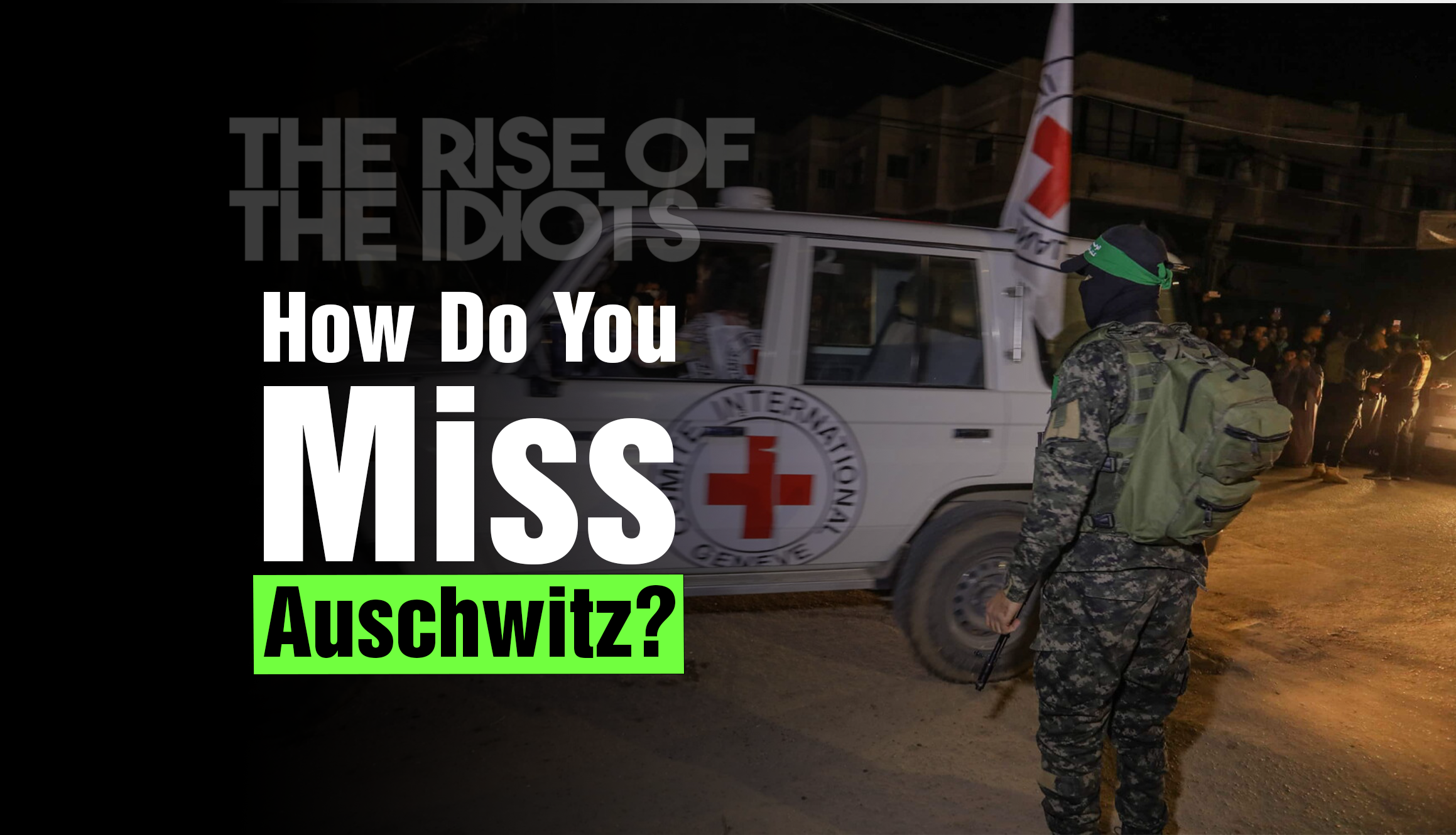
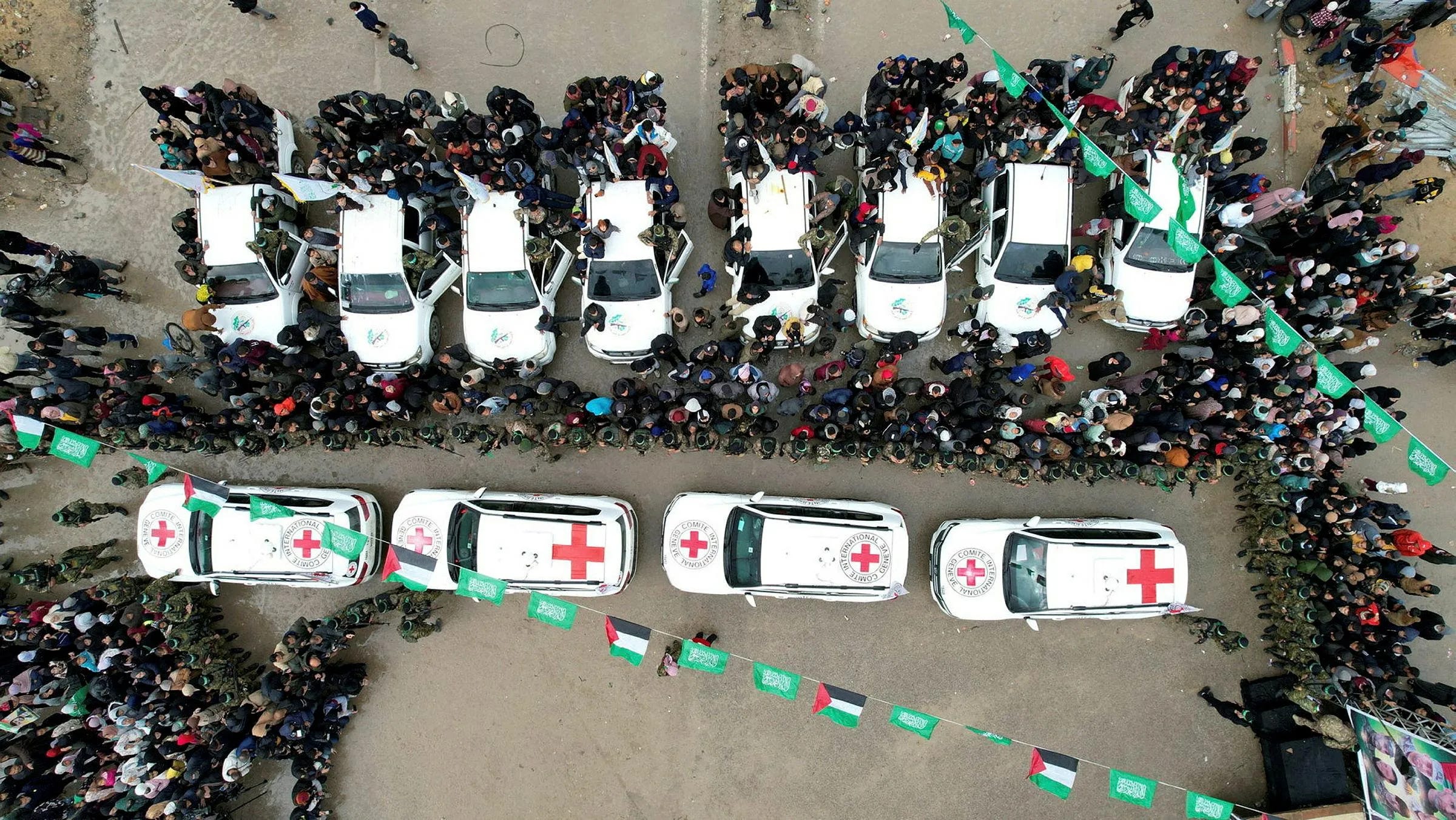
Then, when some hostages were eventually released, Red Cross vehicles appeared at the handovers. Cameras rolled. Armed terrorists posed. Hostages were displayed before crowds and transferred through carefully staged ceremonies designed to make kidnapping look like community theatre.
Apparently there was no access while the hostages were starving in tunnels, but there was excellent access once Hamas needed transport and a respectable logo in the background.
That is convenient.
The Red Cross did not organise the ceremonies, and its representatives were there to take released hostages to safety. That work mattered. But the images were still grotesque. Emaciated captives were paraded on stages. Armed men stood around them. Certificates were handed over, because even terrorists understand that nothing says professionalism like paperwork.
And beside it all stood the emblem of the Red Cross.
Perhaps everyone followed procedure perfectly. That seems to be the problem.
Humanitarian organisations should not become props in propaganda productions. If the captors control the stage, the cameras and the performance, the supposedly neutral intermediary must be extremely careful not to lend the event legitimacy.
Otherwise, it begins to look less like a rescue and more like an awards ceremony arranged by psychopaths.
The Red Cross argues that neutrality is essential. Without it, the organisation cannot communicate with all sides or operate in hostile territory.
Again, fair enough.
But the hostages were never visited.
Their medical condition was not independently monitored. Their families were not given proof of life through the Red Cross. There was no reliable confirmation that medicines reached them.
Neutrality survived beautifully.
The hostages were less fortunate.
Hamas bears responsibility for kidnapping, torturing and starving them. That should not need saying, although modern public debate now requires clarification that kidnappers are responsible for kidnapping. Progress.
But acknowledging Hamas’s responsibility does not place the Red Cross beyond criticism. Quite the opposite. Institutions claiming moral authority should face greater scrutiny, not less.
The pattern is uncomfortable. During the Holocaust, the Red Cross failed Europe’s Jews at the moment they needed it most. After 7 October, it again proved unable to reach Jews held by an organisation openly committed to their destruction, yet appeared when their captors required an orderly public handover.
The two situations are not identical. History rarely repeats itself with the same uniforms and catering arrangements. But the institutional instinct feels familiar: preserve neutrality, protect access, avoid confrontation and explain later why more could not be done.
Then issue a report.
There is always a report.
This is not an argument that the Red Cross is evil. It is not. That would actually make the lesson easier. Evil institutions are simple. You oppose them.
The frightening lesson is that good institutions can fail while remaining convinced of their goodness. They can follow every protocol, use compassionate language and maintain a spotless public image while the people they were created to protect remain abandoned.
Good intentions are lovely. Results are better.
A lifeboat is not judged by the elegance of its neutrality towards the sea. It is judged by whether anyone gets rescued.
The same standard should apply to humanitarian organisations. Did they reach the victims? Did they deliver medicine? Did they verify conditions? Did they resist becoming part of the captor’s theatre?
If not, their intentions may be admirable, but admiration is not aid.
The lesson of Auschwitz is not merely that evil exists. We knew that already. The more disturbing lesson is that respected institutions can stand remarkably close to evil and fail to recognise it, confront it or speak clearly about it.
The lesson of the hostages is that this danger did not disappear in 1945.
We should respect institutions when they earn respect. But we should never confuse a logo with morality, neutrality with courage or an official statement with action.
The Red Cross did not murder the Jews at Auschwitz. It did not kidnap the Israelis taken into Gaza. But when Jews desperately needed the world’s most famous humanitarian organisation, it failed to reach them.
Twice.
Perhaps the third apology will be excellent.
Agreed, but at one of the hostage handovers weren’t some of the Red Cross staff pretty chummy with the Hamas guys? The types of Red Cross volunteers that work in Gaza are not necessarily the types to be super critical of extremist Palestinian nationalism
......and nothing has changed.
Or if it has, only for the worst.